Brahms: Tongue-in-cheek Dances
Classical music is fine, noble, tasteful — and treated as if it were carved in marble. But it doesn’t always have to be.
The rich history of classical music — problematically named to begin with — is anything but boring, if you approach it from the right perspective. Such polemics and discussions are scattered throughout the whole Internet: I wanted to share a slightly different take.
Johannes Brahms published his 21 Hungarian Dances in two batches — Nos. 1–10 in 1869 and Nos. 11–21 in 18801. They were instant ballers and brought him major commercial success — they remain some of his most popular works1. But listen more closely, especially to Nos. 5 and 6, and something else, perhaps more personal, emerges. That’s the topic of this short essay.
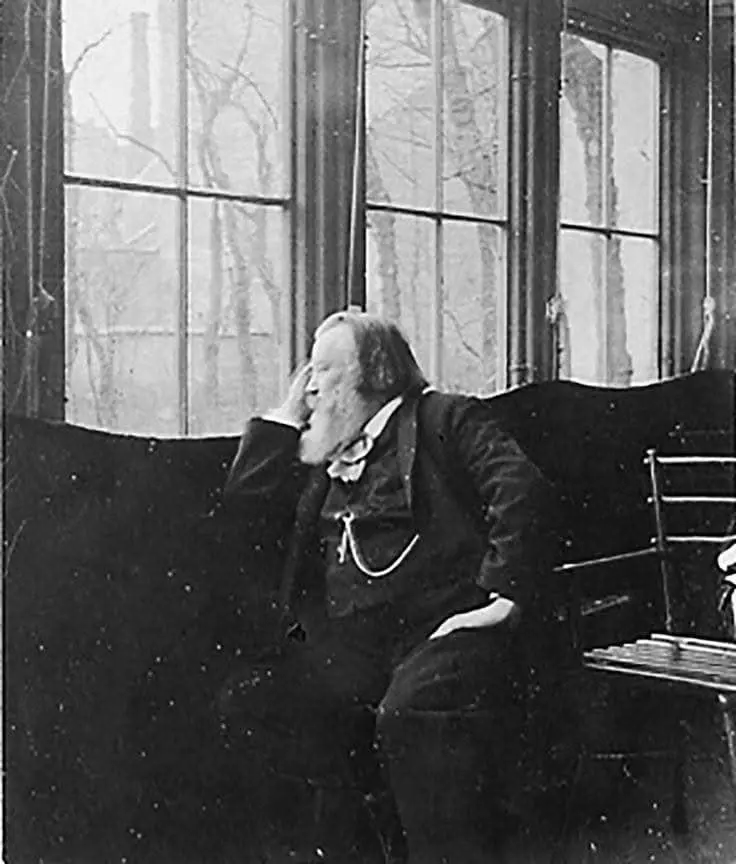 Daydreaming Brahms, probably mentally redrafting his latest fugue for the fifteenth time. Source

Romance in the Air
Intellectuals love taking sides.
In Brahms’s time, one of many intellectual disputes broke out — this time between visions of art.
In today’s world, we could draw an analogy not too far from the War of the Romantics:
Two camps of intellectuals have a beef.
The purists insist that real music comes on vinyl, is played live, and remains untouched by recommendation algorithms. Many of them say music is so wonderful on its own that it needs no further justification to be studied and cherished. High art like this demands formal study, thousands of hours of practice — and thousands of dollars from parents sending their kids to private piano lessons.
This “creative conservatism” comes with a bittersweet nostalgia: “video killed the radio star” and “nobody understands the craft anymore.” If you know Rick Beato, he pretty much ticks every purist box.
 Rick Beato, with his most positive facial expression ever recorded.
The progressivists think music as an isolated art form is an anachronism. We’re past buying vinyl or CDs — and god forbid we promote playing music for fun. That would imply the heretical idea that we should directly support artists, instead of settling for an endless stream of commodified musical gunk from Spotify.
To keep overstimulated zombies engaged, music must be snappy, catchy, and pretentiously provocative. To paraphrase Hašek, it should be “The Music of Moderate Progress Within the Bounds of the Corporate Industry.2”
What about Brahms? More than anything, he loved music — and focused more on making the music solid than on putting on a compulsory show for the audience. Why?
- Even though Brahms never said he was a “purist composer”, he liked music that stood on its own without a story, and he openly pushed back against progressivism, i.e. the trend toward storytelling in music3.
- He opposed programmatic agendas in music, favoring universal, abstract forms.
- He reportedly destroyed at least a dozen, and perhaps as many as twenty, string quartets before allowing one to be published4 — a sign of how little interest he had in leaving behind anything he felt was second-rate.
So yes, Brahms leaned purist — even if he didn’t label himself as such. So, on a surface, you would think he was an old grumpy man, meaning his own “serious business”.
The Comedy Context
In the 1860s–70s, a typical European repertoire looked like this:
Seriousness
Classical Formalism
Beethoven, Mendelssohn, Schumann
- Steady sonata forms
- Well-established structures
- Efficient use of musical ideas and strict structure
Beethoven's Symphony No. 5 (1808)
Programmatic
Storytelling Music
Wagner, Liszt, Berlioz
- Narrative-driven
- Leitmotifs and themes
- Emotional extremes
Wagner's Tristan und Isolde (1865)
Polished Ballrooms
Social Dance Music
Johann Strauss II, Josef Strauss
- Triple-meter elegance
- Predictable rhythms
- Ballroom music
Blue Danube Waltz (1867)
How does Brahms fit into this? He went a completely different way than his contemporaries — Hungarian Dances weren’t grand symphonies or epic pieces filled with emotional rollercoasters, but were rather showing that sticking to pure musical ideas can still be exciting and worthwhile.
Hungarian Dances No. 5 and 6
Hungarian Dance No. 5 in F♯ minor is probably the most famous (and controversial) of all the dances5. You’ve probably heard it many times and may wonder what I’m on about. It’s a classic — what’s so witty or comical about it?
When Brahms composed it, he was fascinated — and getting intimate — with the csárdás, a Hungarian folk dance known for its two-part tempo shifts: a slow lassú followed by a fast friss6. And No. 5 oozes csárdás!
Side note: Johannes Brahms didn’t dream up the main theme of No. 5 from scratch — it’s from Béla Kéler’s Bártfai emlék, which Brahms apparently thought was a genuine folk tune7. Thinking it was a folk tune, he felt fine using the whole thing. As you may have guessed, Kéler felt otherwise.
Several of the Hungarian Dances were Brahms’s own inventions in Hungarian style13, while many reworked existing melodies5. The whole set helped spread Hungarian-style dance music to audiences all over Europe.
To me, No. 5 is a slap in the face to the program music giants of the era. It’s like a kid walking into a room full of serious adults arguing about whose work is the most epic and grandiose, and just laughing at the whole scene.
Granted, I might be overreading this. The Hungarian Dances may not have been meant as mockery. Still, the creativity and freshness make them feel that way. That ambiguity only adds to Brahms’s genius.
If No. 5 winks at tradition, No. 6 practically trips over it. No. 6 in D♭ major5 leans even more into playfulness. Listen to this absurdly rhythmically unbalanced piece:
Brahms’s Hungarian Dances showed a new way forward — one that Janáček, Bartók, and even Jón Leifs would later take in their own directions. Brahms proved that blending folk and Western art music doesn’t have to be sentimental; it can be refreshing and exhilarating.
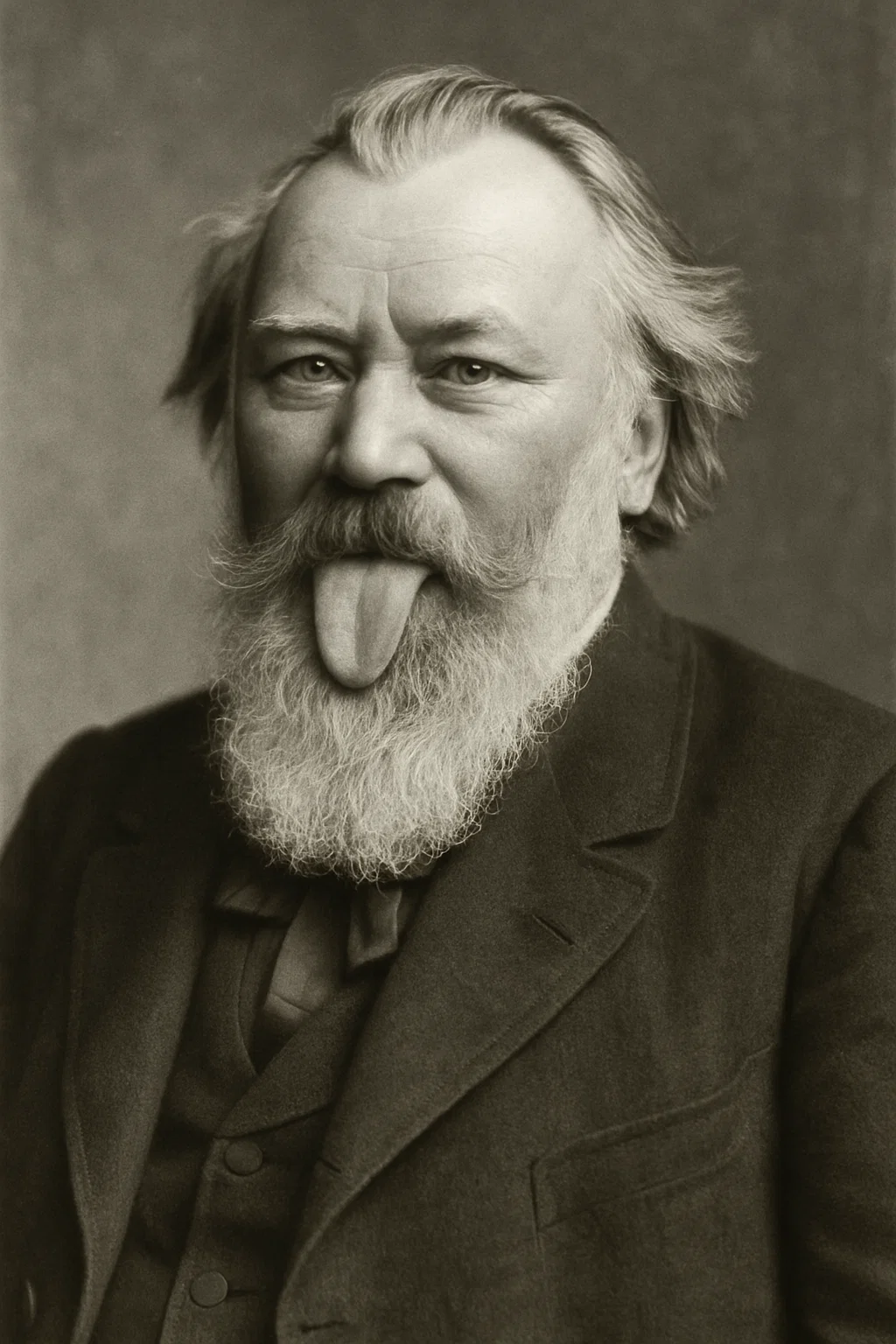
Brahms is usually considered a serious man8, but I think he always had an inner child — and if Hungarian Dances needed an album cover, I’d like to think it’d look something like this:
It does not end with Brahms
Decades later, Shostakovich pulled a similar trick — but with life-threatening stakes. Where Brahms teased his contemporaries with a dance tune, Shostakovich trolled Stalin with a symphony.
It’s 1945, the year when very few people in Europe felt like dancing to The Blue Danube. The Red Army, alongside the 1st Polish Army, advances into Germany and by 2 May raises Polish flags in central Berlin9. The sacrifice is immense, but at least one horror is over. Stalin now has the perfect chance to consolidate a ruined Soviet Union.
Shostakovich’s Symphony No. 9 subverted official expectations of a monumental victory ode with a terse, almost sneering score10.
Martin Keary explains this brilliantly in his YouTube video.
References
-
Bozarth, G. (2024). Hungarian Dances. In Grove Music Online. Oxford University Press. https://doi.org/10.1093/gmo/9781561592630.article.13650 ↩︎ ↩︎2 ↩︎3
-
In 1911, Jaroslav Hašek founded a satirical political party named The Party of Moderate Progress Within the Bounds of the Law. ↩︎
-
Erklärung der gegen die Neudeutsche Schule gerichteten Partei (1860). Reprinted in Swafford, J. (2023). Johannes Brahms: A Biography. Knopf. ↩︎ ↩︎2
-
Los Angeles Philharmonic. (n.d.). String Quartet No. 3 in B-flat, Op. 67. Program notes. https://www.laphil.com/musicdb/pieces/3717/string-quartet-no-3-in-b-flat-op-67 ↩︎
-
IMSLP Work page for Hungarian Dances (original keys and orchestrations). https://imslp.org/wiki/Hungarian_Dances_(Brahms%2C_Johannes) ↩︎ ↩︎2 ↩︎3
-
Csárdás. (n.d.). In Encyclopaedia Britannica. https://www.britannica.com/art/csardas ↩︎
-
Banks, P. (2021). Brahms’s Hungarian Dance No. 5 and Béla Kéler’s Bártfai emlék. Music & Letters, 102(4), 617–645. https://doi.org/10.1093/ml/gcab100 ↩︎
-
https://www.reddit.com/r/classicalmusic/comments/p6riou/was_brahms_humourless/ ↩︎
-
Institute of National Remembrance (IPN). (n.d.). First to Fight: The Polish Army in Berlin, May 1945. https://ipn.gov.pl ↩︎
-
Los Angeles Philharmonic. (n.d.). Symphony No. 9. Program notes. https://www.laphil.com/musicdb/pieces/2860/symphony-no-9 ↩︎