🌴 Addiction Island 🌴
Homme fatale
Everyone wants a life-long partner. Or at least that’s what you hear so often these days. You’ve probably heard it in one shape or flavour or another:
“I’m looking for my second half which will complete me.”
“There is a soul mate for everyone somewhere.”
“I’m waiting for my (wo)man.” (Not a Velvet Underground reference! Well… sort of.)
“I have high standards for my romantic partner.”
The idea of searching for the love of our life has been with us for millennia. To illustrate the universality of this desire, let’s invoke Plato’s Symposium (heavily paraphrased):
Original humans weren’t like us: there were three sexes—male, female, and androgynous. Each was spherical, with four arms, four legs, two faces on one head. Grown arrogant, they attacked the gods. Zeus, choosing to weaken rather than destroy them, split each in two—like halving an apple or an egg.1
Like many other things in our lives, this urgent portrayal of vital human connection and relationships has been commodified heavily. The obligatory example of such misuse is online-dating apps — think Badoo or Tinder — but that’s far from the only case.
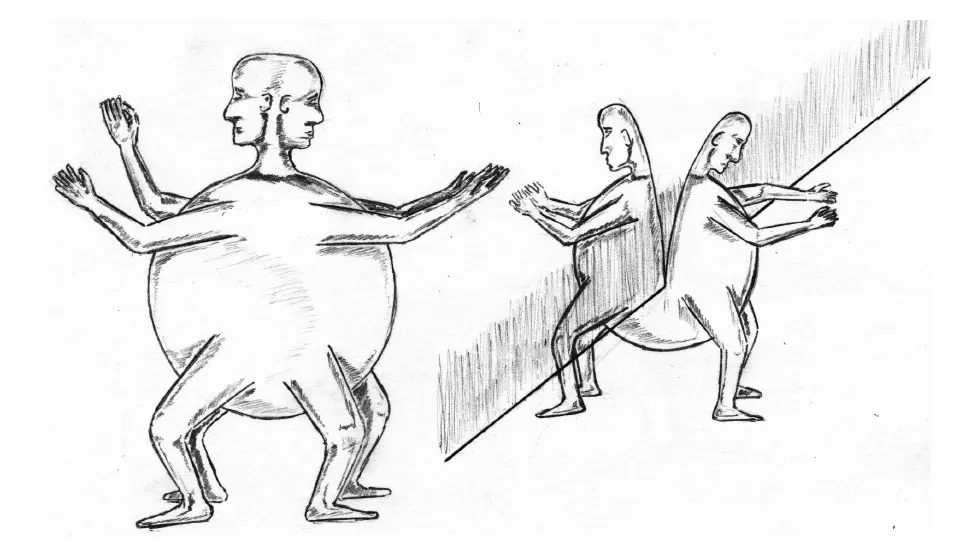 Gods gave us new meaning of life in the search of our missing half. Source: Neel Burton

In this article I’d like to dissect and decompose some of the principles behind romantic reality shows, such as Love Island, which have gained immense popularity recently.
Love is on the air
Reality shows have quietly taken over our screens. Even though it’s hard to pinpoint precise popularity statistics from public data, reality TV has been with us for more than 20 years now, starting with big names like Idol, Survivor or Big Brother.
While scripted shows have reportedly declined in recent years23, public awareness of reality-format products is still likely quite high — in the higher tens of percent45 — and they are arguably a major influence on our values and moral ideals.
Recently, reality TV has even “coupled up” with social media to provide nonstop streams of content, making awareness — and consumption — even more likely.6
TV lives on suggestive visuals. Obviously! But creators should also consider who’s watching.
Perfect body positivity
Appearances — of ourselves and of others — matter and always will, especially among teenagers and young adults. The only thing we have in control, then, is how we value and work with physical attractiveness or its absence. Consequently, the way we perceive our own body is directly and deeply connected with our well-being and self-worth.
According to a YouGov survey of 4,505 UK adults, almost one in four people (24%) aged 18–24 say reality TV makes them worry about their body image.78 GoodTherapy likewise summarises research and commentary on the “Love Island Effect,” in which viewers don’t just watch the show but start to question their appearance and consider cosmetic procedures.910
Some of the “consumer-behaviour specialists” (whatever that means) don’t seem to care about this; on the contrary they claim that these shows are actually saving the young from loneliness:6
“When ‘Love Island’ fans come together to watch the program at bars and restaurants, they’re not consuming content as much as co-creating a shared emotional habit.”
At the same time, they note that the format leans on parasocial connections — which, given the fragile self-perception of some young people, may actually deepen the issue, as you now have someone to relate to (as opposed to Hollywood celebrities who are usually put on pedestals).
Research also suggests that young people who desire to change aspects of their body tend to report greater pressure to conform to media ideals.1112 In other words: it doesn’t end with “I wish I had tits like Tanya from Love Island”; many times it ends up with actual body interventions, or at least serious thought about them.
As one might expect, this isn’t entirely new: exposure to idealised bodies in the media is associated with deteriorations and distortions in self-worth and body image.1314
But the show’s message doesn’t end with physicality — it also passes far more nuanced, often subconscious cues to its viewers.
Authentic communication is everything
A more sophisticated set of “ideals”, amplified in reality shows, can be summed up as: “communication is important and the basis of a healthy relationship,” and “be your authentic self.” These mantras are also popular among young women.15 But although they sound profound, once you unpack them they offer little in the way of specific insight or guidance — and worse, they may be harmful.
If the purpose of Hare Krishna is to create a repetitive rhythm by which you accept omnipotence and allow for the greatness of Hinduistic gods, what purpose does the over-use and internalisation of “communication is important” and “authentic self” have?
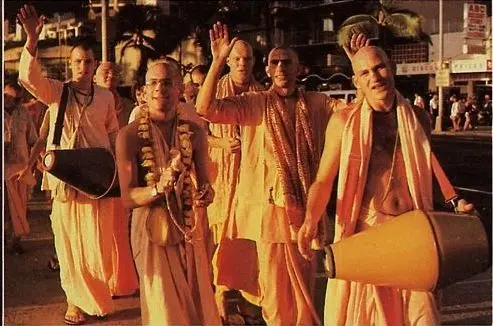 Romantic people, as seen in their natural habitat. Source: The Hare Krishna Movement

It’s easy to shrug and say “it’s not that deep, I just watch it for entertainment.” Sure. But it’s also well-established that people gradually absorb ideas, views, and moral cues presented in media they regularly consume.16
My personal note here: even denying and suppressing such ideals and morals constructs one’s perspective. If I’m regularly exposed to idealised human body shapes, one way this might change my behaviour is that I would abandon and despise the physicality of human nature completely because so far, I’ve mostly seen the superficial part of it.
On the small positive side: qualitative research suggests that young people at least seem aware of the “fakeness” of relationships presented in Love Island.15 However, this awareness comes with a caveat: there are many aspects of the show that rarely get scrutinised. The importance and value of fame brought to contestants is one of many examples. Sheri Jacobson, clinic director of Harley Therapy, aptly points out that “Fame is the dreamed-of panacea to finally quell (those) secret feelings of inadequacy.”17
There are also people who argue that viewers of Love Island see “regular” people grow into successful and famous personas. This is disputable: it’s common for the show to pick already “instafamous” contestants scouted by production teams.18
There is yet one other quality of reality shows which could help us further understand its appeal and popularity.
Peacocking escapism
By design, everything on reality TV is performative: if the story gets too boring, TV producers risk losing a considerable number of viewers.
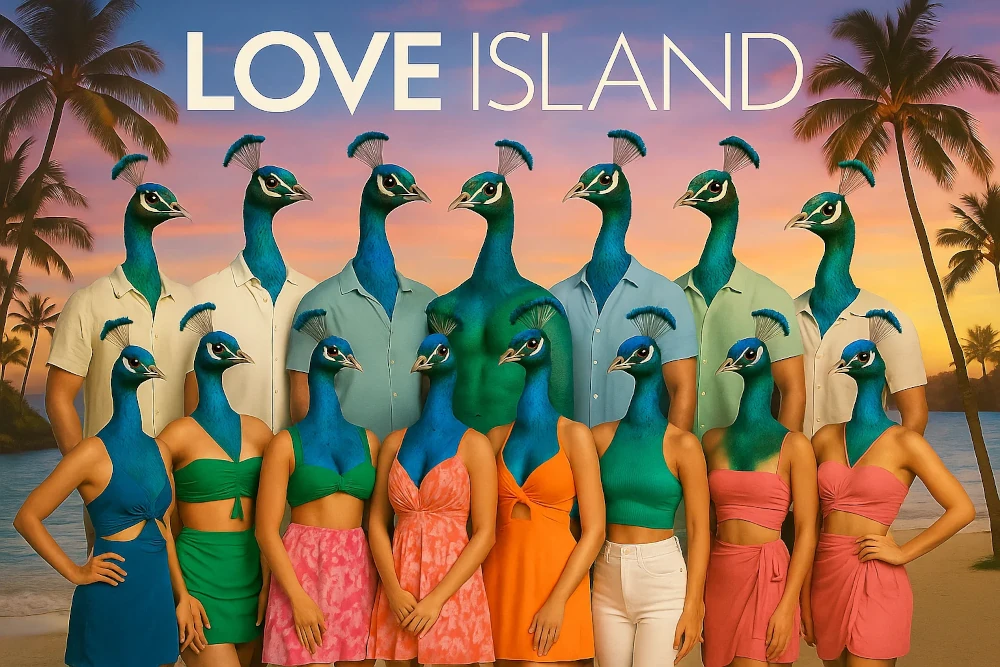 Group photo of Love Island participants before software postprocessing. Created by Sora v1.
The oversaturated and overstimulated world reality shows offer might be detrimental not only for participants themselves but for viewers as well. As already mentioned, viewers might recognise the show feels fake and performative — but on the other hand it doesn’t often get discussed that the show may leave you thinking life (arguably not only romance) must be full of turns, twists, drama and exciting moments.
So, instead of accepting the fact that a part of your life can be dull, monotonous, and boring — escapism to reality TV creates addictive patterns that are comforting: “at least here, something is happening!”
It’s no wonder shows like Love Island attract young people to participate, given the attention it brings. When the islanders are “living in the moment”, they may feel in complete control and all-powerful; in hindsight, however, when they return to regular life, wouldn’t at least some of them feel manipulated into being entertainment clowns who were just in it for other people’s delight?
So what?
You might say: “Yeah, sure — Love Island is trash and a piece of crap, thanks for stating the obvious in so many sentences!” That’s exactly why I’d like to end with a glimpse of optimism and hope. I don’t necessarily think all is lost here.
The fact that reality shows are consumed by kids and young adults will hardly change in the coming years. So, what if we used this phenomenon for their benefit, and taught them how to discuss and open up about abusive patterns and inappropriate behaviour in romantic relationships?
Watching and analysing the show itself in class will hardly make any difference; playing out personally the Love Island arena as bounded drama, with specific intentions and rules, might actually become a life lesson that will stick with them. With sufficiently skilled educators, this could bring us closer to the problems and issues experienced by young people perhaps more than we could imagine.
There’s a bit of an actor in all of us — let’s use that skill where it might make a difference.
References
-
Aristophanes’s Speech from Plato’s Symposium. Trans. Benjamin Jowett. Project Gutenberg: https://www.gutenberg.org/files/1600/1600-h/1600-h.htm ↩︎
-
https://variety.com/2024/tv/news/peak-tv-tally-original-scripted-series-aired-2023-1235902886/ ↩︎
-
Additional context on the 2023 decline: https://variety.com/2024/tv/news/us-scripted-tv-shows-2023-peak-tv-study-1235877669/ ↩︎
-
https://today.yougov.com/ratings/entertainment/fame/current-tv-shows/all ↩︎
-
What “Fame” measures (YouGov Ratings FAQ): https://today.yougov.com/about/ratings-faq ↩︎
-
“Co-creating a shared emotional habit” (faculty Q&A): https://news.darden.virginia.edu/2025/07/18/love-island-just-wrapped-what-did-we-learn-from-the-watch-party-trend/ ↩︎ ↩︎2
-
https://www.theguardian.com/tv-and-radio/2019/jun/03/reality-tv-fuels-body-anxiety-in-young-people-survey-love-island ↩︎
-
Mental Health Foundation release (same stat): https://www.mentalhealth.org.uk/about-us/news/mental-health-foundation-criticises-new-series-love-island-it-releases-new-statistics-about-body ↩︎
-
https://www.goodtherapy.org/blog/how-reality-tv-like-love-island-impacts/ ↩︎
-
Also see Nuffield Council commentary on cosmetic-procedure consideration among 18–24s: https://www.nuffieldbioethics.org/news-blog/love-island-and-cosmetic-surgery-ads-time-to-decouple/ ↩︎
-
https://doi.org/10.1007/s40894-015-0016-6 ↩︎
-
https://www.academia.edu/128886017/Men_and_muscularity_research_a_review ↩︎
-
https://linkinghub.elsevier.com/retrieve/pii/S1471015313000457 ; https://doi.org/10.1016/j.bodyim.2020.11.005 ↩︎
-
https://osf.io/preprints/psyarxiv/8zrtn_v1 ↩︎
-
Communication Theory, 16(3), 333–355 (cultivation & perceived distance): https://doi.org/10.1111/j.1468-2885.2006.00273.x ↩︎
-
https://www.vogue.co.uk/article/the-psychological-impact-of-love-island ↩︎
-
On scouting/“instafamous” casting: https://metro.co.uk/2019/08/04/which-2019-love-island-contestants-applied-for-the-show-10515592/ ↩︎