Heuri: Motivation and First Baby Steps
Yet another EdTech product?
In the prologue of this series, I presented quite an ambitious plan: to build a system that will move beyond math learning through the lens of merchant math and will propagate the strength of mathematics via exploration and creation. As I’m aware that such a project is ambitious, one of the purposes of this series is to find like-minded people. Whether you want to leave a short comment on what your experience is or you want to contact me for possible collaboration, you are welcome to do so!
To give you an idea why it makes sense to build such a system, let’s go through existing options:
Disciplined Self-study in the World of Generative AI
Reading articles, books, textbooks, or simply put: doing math on your own. This is the path I’ve personally taken and from my experience, it requires enormous discipline. This pathway is effective if you love math. Not to mention, in many cases, you are not guaranteed that the learning sources are correct and you usually have nobody to verify the result for you. This is especially crucial for GenAI products that are immensely helpful, but with a significant caveat: ChatGPT, for example, is not designed for many tasks high schoolers do, especially when it comes to doing numerical computations.
One could argue that in the very near future, there will be agentic systems that will automatically reroute such tasks to verified and battle-tested solutions, e.g. WolframAlpha, but that’s exactly my point: you already have to know your way around solving problems and navigating in the sea of LLM hallucinations in case anything goes wrong. That’s exactly an obstacle you don’t want to grapple with when you have no idea how to approach such a problem.
Personally, I’ve leveraged Gemini Pro to check my mathematical proofs I roughly already know how to do. Gemini Pro has given me insightful feedback already, but I always take its solutions with a grain of salt. The other problem is that GenAI products are designed to be overly accommodating and rarely point out fundamental flaws in a student’s reasoning. I elaborate on the pitfalls of using GenAI in another article. GenAI is built for general assistance, leaving space for a specialized, pedagogically-driven system like Heuri.
Students I personally tutor have also commonly reported that even if ChatGPT gives them solutions, they don’t fully understand the explanations as they are overly complicated. Also, a GenAI product will not teach you how to ask the right questions because it does exactly the opposite: it takes this responsibility and skillset from you by trying to solve everything for you. If you’re a professional mathematician, GenAI is an amazing and brilliant helper; if you’re a demotivated student, it’s potentially a counterproductive tool.
MOOC
I took a few MOOC courses and the structure was basically always the same: you are given a series of videos and material you usually sequentially go through and finish—sometimes with very creative assignments, admittedly. In essence, though, many MOOC courses are digitized versions of the merchant system: they give you a fixed set of problems and skills you learn, offering you very little flexibility.
The rigidity of such systems is commonly outweighed by interactivity with other students which is the only thing that personally made me come back for MOOC courses. If the MOOC course didn’t have many active students, the whole experience felt sterile and disconnected.
To be clear: MOOC courses get things done quickly and are a great option for learning given you are already interested in the topic. On the other hand, there is a low chance an “Algebra II” MOOC course will make you passionate about math if you aren’t already. Heuri deals with a completely different problem: getting the student to be interested in the topic in the first place.
 Online courses sometimes feel to me like digitized exercise books. Image source
Online tutoring
There are many Czech math tutors, among many of which are Marek Valášek or Dominik Hládek. They provide help focusing on Czech high school math and in my eyes, they explain the topics with clarity and passion. Recently, I’ve also seen Twitch streamers, some of them refreshingly interesting. Streaming looks like a promising pathway, if approached correctly, ČT Edu did an amazing job in this regard already.
Online tutoring of Czech math has a common denominator. It does not discourage its students from merchant math, it’s only a more digestible merchant math in the form of contrived “real-world” examples, which is not an optimal approach, as I explain in the prologue. It’s not that tutors wouldn’t be capable of approaching teaching differently, it’s more that tutors usually know very well that students come for a quick, hotfix solution to their short-term problem: I need to pass my exams, I need to prepare for entrance exams or resits. Tutoring serves this purpose amazingly well.
Individual tutoring
This approach has the potential to be the most effective but at the same time, it’s most resource-consuming of all the methods. Tutors—provided they possess the necessary pedagogical skills—can fully focus on students’ strengths and weaknesses. Even though individual tutoring has its strengths, it commonly patches the effects of the system. Therefore, I think dealing with the causes of such rigidity is much more efficient.
Constructivist schools
The critique of merchant math isn’t something new. In fact, there are people who dedicated their whole life by presenting education system alternatives that build on fundamentally different concepts. My biggest source of inspiration—and the reason I strongly believe Heuri will be a successful project—is the lifelong work of Milan Hejný and his father Vít Hejný.
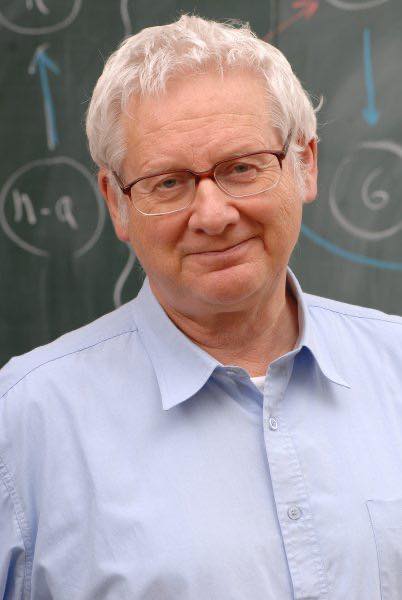 Milan Hejný, a professor at The Charles University. His main field of expertise is didactics of mathematics.
Even though I’m drastically oversimplifying here, Hejný believes that a student should build and experience mathematics by means of creating and discovering it. I see three main pillars in his method:
I. Building Schemata
Instead of being given a series of unrelated topics, students build a rich and strongly interconnected knowledge base and set of skills. The way to achieve this is to embrace a new problem—not too tough, not too easy—by incorporating it into their existing network.
II. Personal Knowledge
Success in learning is framed not as finishing first or outperforming peers, but as overcoming a personal cognitive challenge. Such a challenge isn’t arbitrary and contrived by an authority but is designed to be captivating at the individual student level.
III. Guidance
Teachers are not authorities from which students primarily learn new things; teachers adopt the role of class discussion moderators and treat mistakes of students as an opportunity to move forward.
Have you ever experienced—practiced even—this kind of mathematical guidance?
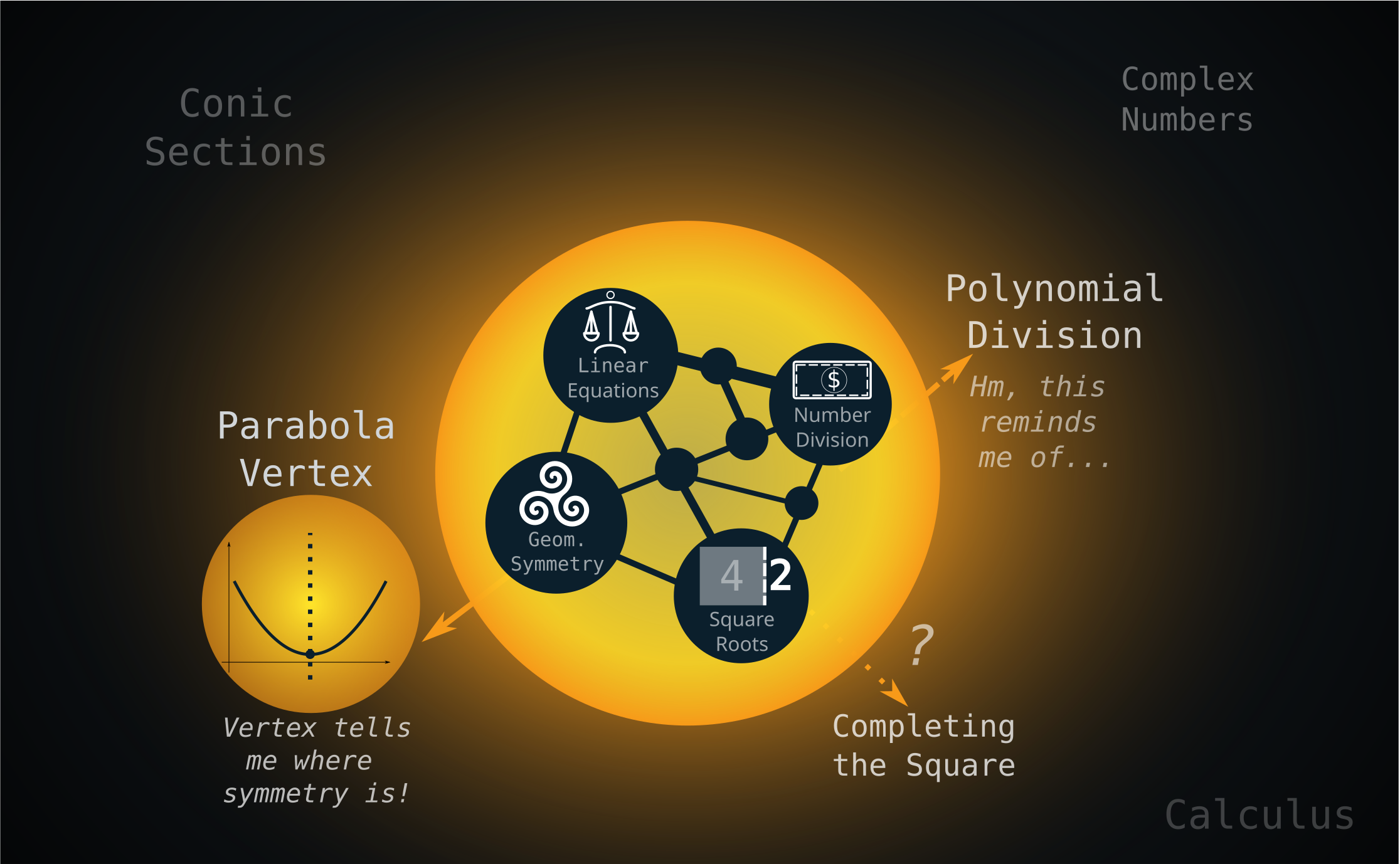 Building schemata: students incorporate new problems into their existing, strongly interconnected network of knowledge. Image source: MŽE.
The framework of Hejný is a part of a broader family of educational philosophies called constructivism. Several pioneering Czech schools have successfully adopted constructivist elements in their education:
- ScioŠkoly (ScioSchools): A rapidly expanding network of over 25 schools across the Czech Republic that has moved from traditional, rigid subject boundaries. Subjects are taught in context via real-world projects and highly targeted micro-courses.
- ZŠ a MŠ Labyrint (Brno): A laboratory school utilizing Montessori elements where students independently discover complex concepts using physical manipulatives.
- ZŠ Kunratice (Prague): A recognized hub for constructivist teaching where the Hejný methodology is deeply embedded.
To sum up, students have optionality when it comes to learning math. Even though there already are institutions moving past merchant math, optionality is still very often fixating on the various ways of “going through math”. Perhaps I’ve missed an alternative you know about; in that case, please let me know!
Heuri as a Constructivist Platform
Heuri is meant as a constructivist learning platform, reflecting the education philosophy of Hejný. I’m personally convinced we need more EdTech that preserves student independence and invites discovery.
What Heuri Does Not Aim to Solve
- Be a math learning panacea for everyone
- Offer a compendium of all possible math there is: it will be a system adapted and specialized for Czech high school math, which is a large subset of math already
- Create the innate world for the student or quickly prepare them for an arbitrary exam X
What Heuri Aims to Solve
- Adapt to student’s needs and way of learning/thinking, especially by tracking types of mistakes they do and topics that are difficult to them, through the means of machine learning
- Show that mathematics is about problem solving, including problems one hasn’t seen yet
Pitfalls I’m Anticipating
- I’m starting Heuri as a solo developer without a magic wand. The project is complex and designing it from scratch is risky. There is only one way to find out whether the risk is worth it.
- I know nothing about machine learning but want to create a solid, cost-effective ML architecture that will honor user privacy by design. It is potentially a massive time sink but I’m willing to bite through it.
- Heuri must not be a proxy for selling data about math students: if the project is not self-profitable, then it’s a project deemed to be stopped, period. There will be no magical and silent updates of “Ethical Codex”: the system must be ethical and transparent about all it’s doing by design.
- I don’t know how to share the project among other people, either those who want to collaborate on its development or its end users. I consider this to be the least important issue, however: many good ideas have spread quickly without millions of dollars to be spent.
Where to Start?
I have three primary areas of focus:
- I need to work on how to design Heuri so that it’s pedagogically sound and does more good than harm. From my experience, choosing a technology stack is the last choice. Business criteria and functional requirements must be declared first.
- I need to figure out how to find likeminded people. That’s why I’m using Substack. If you’re reading this article, this point is already happening!
- I need to learn the basics of machine learning as ML will be the backbone of Heuri.
That’s why the upcoming articles will probably be a mix of all of these. Happy learning!